

Which is right for you?
-
Source: Samsung
Samsung Galaxy Watch 5
Our top pick
The fifth generation of Samsung’s successful Galaxy Watch series is an incremental update over its predecessor but offers a refined smartwatch experience that remains hard to beat.
Pros
- Better battery life
- Better value (especially the 44mm version)
- Takes any 20mm strap
-

Source: Google
Google Pixel Watch
A solid alternative
$295
$350
Save $55Google’s first ever smartwatch has a whole lot going for it, including Fitbit integration and a stylish look that really makes it stand out on the wrist.
Pros
- Distinctive look
- Good blend of Google hardware and software
- Fitbit integration
Cons
- Weak battery life
- High price of entry
- Proprietary straps
Samsung’s Galaxy Watch 5 and Google’s Pixel Watch were the two top contenders for smartwatches in 2022, and while Samsung’s wearable has been superseded on our list of the best smartwatches by this year’s Galaxy Watch 6, the prior model is no slouch; it’s still a great reliable pick, especially if you’re looking to save a few bucks, or you’re looking for a color that’s not available in this year’s model.
On the other hand, the Pixel Watch remains the first and only option in Google’s Wear OS lineup. This relatively new entry may have you wondering if it’s a better choice than Samsung’s more established smartwatch line, especially if you’re already a fan of Google’s Pixel smartphone lineup.
While both smartwatches have attractive, eye-catching designs and run the latest Wear OS, there are some significant differences between them that will impact your buying decision. The good news is that we’ve put them through the paces and have a head-to-head comparison to make sure you have all the info you need.
Price, availability, and specs
Although not typically known for cut-price
wearables
, this is one category where Samsung has Google categorically beat. At release, the cheapest Samsung Galaxy Watch 5 started at just $280 for the smaller 40mm without 4G LTE; adding the cellular capabilities took the price up to $330. The 44mm models, meanwhile, came in at $310 or $360 if you need LTE. Both sizes are available with a leather strap for $10 extra. However, those prices have dropped significantly with the release of the Galaxy Watch 6, with Samsung now selling the 40mm LTE version for only $230, presumably while supplies last. Similar discounts can be found at most other retailers.
The Google Pixel Watch only comes in one size, which simplifies things considerably. It’s available without cellular connectivity for $350 or with for $400, making it much more of an outlay than the Galaxy Watch 5 — but that’s before you get onto the optional extra straps, which go all the way up to $80 (with the metal mesh band pegged at $130).
-
Samsung Galaxy Watch 5
Google Pixel Watch
Display 1.19″ Sapphire Crystal Glass AMOLED 396x396px (40mm) or 1.36″ Sapphire Crystal Glass AMOLED 450x450px (44mm) 1.6-inch 384 x 384 AMOLED, Always On Display CPU Exynos W920 Exynos 9110 SoC, Cortex M33 co-processor RAM 1.5GB 2GB Storage 16GB 32GB Battery 284mAh (40mm) or 410 mAh (44mm) 294mAh Connectivity NFC, GPS, Bluetooth 5.2, Wi-Fi (2.4Gz & 5Ghz), LTE (optional) 4G LTE, UMTS, Bluetooth 5.0, Wi-Fi 802.11 b/g/n 2.4GHz, NFC, GPS, GLONASS, BeiDou, Galileo Durability IP68, Waterproof to 50m (5ATM), MIL-STD-810H 5ATM Software One UI Watch (Wear OS 3 powered by Samsung) Wear OS 3.5 Health sensors Optical Heart Rate, Electrical Heart Sensor (ECG), Bioelectrical Impedance (BIA), Continuous SpO, Skin Temperature Sensor Optical heart rate sensor, Multipurpose electrical sensor, Blood oxygen sensor, Accelerometer, Gyroscope, Altimeter, Compass Price From $280 From $350 Strap 20mm Active band included: Small (130 – 175 mm) and Large (165 – 210 mm) Dimensions 40.4 x 39.3 x 9.8 mm (40mm) or 44.4 x 43.3 x 9.8 mm (44mm) 41 x 41 x 12.3 mm Weight 29 (40mm) or 32.8g (44mm) 36g Mobile payments Samsung Pay, Google Wallet Google Wallet Workout detection Yes Yes Color options Silver, Graphite, Pink Gold (40mm only), Sapphire (44mm only) Matte Black with Obsidian Active band, Polished Silver with Charcoal Active band, Polished Silver with Chalk Active band, Champagne Gold with Hazel Active band
Display: Distinctive or familiar

Both watches sport a round face, but that’s where the similarities end in terms of their looks. While tastes will vary, Google’s Pixel Watch is probably the aesthete’s choice. Its 3D glass dome gives the timepiece an eye-catching raised effect, which also does a rather good job hiding its thick bezel. It’s also masterfully minimalist, featuring a barely visible side button and a digital crown for the classic wristwatch look.
It comes in three colors — Matte Black, Polished Silver, and Champagne Gold — and only one size: 41mm, with a 1.2-inch AMOLED screen. It’s not the thinnest wearable around, measuring 12.2mm thick, and it’s quite weighty at 36g.

Unlike the Pixel Watch, the Samsung Galaxy Watch 5 comes in two sizes: 40mm and 44mm with 1.2 and 1.4 inches, respectively. Both sizes are thinner and lighter than the Pixel Watch at 9.8mm, with weights of 28.7g and 33.5g.
Its design is also a bit more sporty, with a flat screen and two side buttons. It lacks a crown but has a virtual touch bezel around the outside, allowing you to pick between apps by swiping around the edge. Sadly, the physical twisty bezel of the Galaxy Watch 4 Classic isn’t available this generation.
If you opt for the Samsung wearable, you get a slightly wider choice of colors, as both sizes come in Graphite or Silver, with Sapphire available on the 44mm model and Pink Gold as an
exclusive
option for the 40mm version.
One last thing to note: while the Samsung Galaxy Watch 5 accepts any standard 20mm strap, the Pixel Watch has a proprietary connecting mechanism that means only bands designed for it will fit. That’s something to bear in mind if you like to accessorize.
Software: Pure Wear OS, or with a Samsung sheen?

Both watches run Wear OS, which means that they can be expanded with additional apps via the Google Play Store. With 32GB of storage, the Pixel Watch has more space for this and offline music, though the 16GB Galaxy Watch 5 isn’t exactly short of storage capacity either.
In terms of apps, it’ll come down to personal preference, but bear in mind that the Pixel Watch is a reference device for what Google software looks like when combined with Google hardware. As such, it’s Google heavy with Wallet, Assistant, YouTube Music, Maps, Home, and Calendar all built in.
The Galaxy Watch 5 has a bit of Google but also offers Samsung alternatives where available. That means you get to choose between Google Pay and Samsung Pay, or Google Assistant and
Bixby
. The flexibility doesn’t end there. While the Pixel Watch only lets you download music from apps like Spotify and YouTube Music, the Galaxy Watch 5 allows you to import tracks directly from your smartphone.
Neither wearable is exactly slow, but it’s worth noting that the 10nm Exynos 9110 processor used by the Pixel Watch is four years old now, and it doesn’t feel quite as snappy as the 5nm Exyos W920-toting Galaxy Watch 5.
Health & fitness: Drawbacks on both watches
Like most smartwatch makers, both Samsung and Google have decided that fitness is an integral part of the wearable experience. As a result, both go big on sensors and features, though it’s fair to say neither is perfect, and true fitness heads might want to go after a dedicated running watch instead.
In terms of raw sensors, the Samsung Galaxy Watch 5 is the clear winner. As well as the usual heart rate, GPS and blood oxygen tracker, Samsung’s wearable packs in sensors to measure body fat composition and skin temperature, though the latter is currently awaiting activation. If you have a Samsung phone, the watch also has the ability to measure blood pressure and take an ECG.
It’s an impressive package on paper, but the Watch 5 has weak spots. In particular, GPS accuracy isn’t especially strong, leading to some quirky run tracking, and the Samsung Health app is also very much an acquired taste. Still, with support for 90 exercises — and automatic detection for six of them — it remains a good option for casual fitness fans who don’t sweat the granular detail.
The Pixel Watch’s big selling point on the health front is that its fitness features are powered by Fitbit, a company it acquired back in 2021 for $2.1 billion. That means that exercises are tracked within the excellent Fitbit app, which is extremely user-friendly and a decent fitness social network in its own right.
It has fewer advanced sensors than the Galaxy Watch, though it does support ECG and blood-oxygen tracking (albeit not yet enabled in the case of the latter). And like the Galaxy Watch, it isn’t great for GPS accuracy either and lacks any kind of automatic workout tracking. Most importantly, the Pixel Watch might not be the best for tracking long bike rides or runs thanks to its Achilles heel: battery life.
Battery: Have your charger on standby
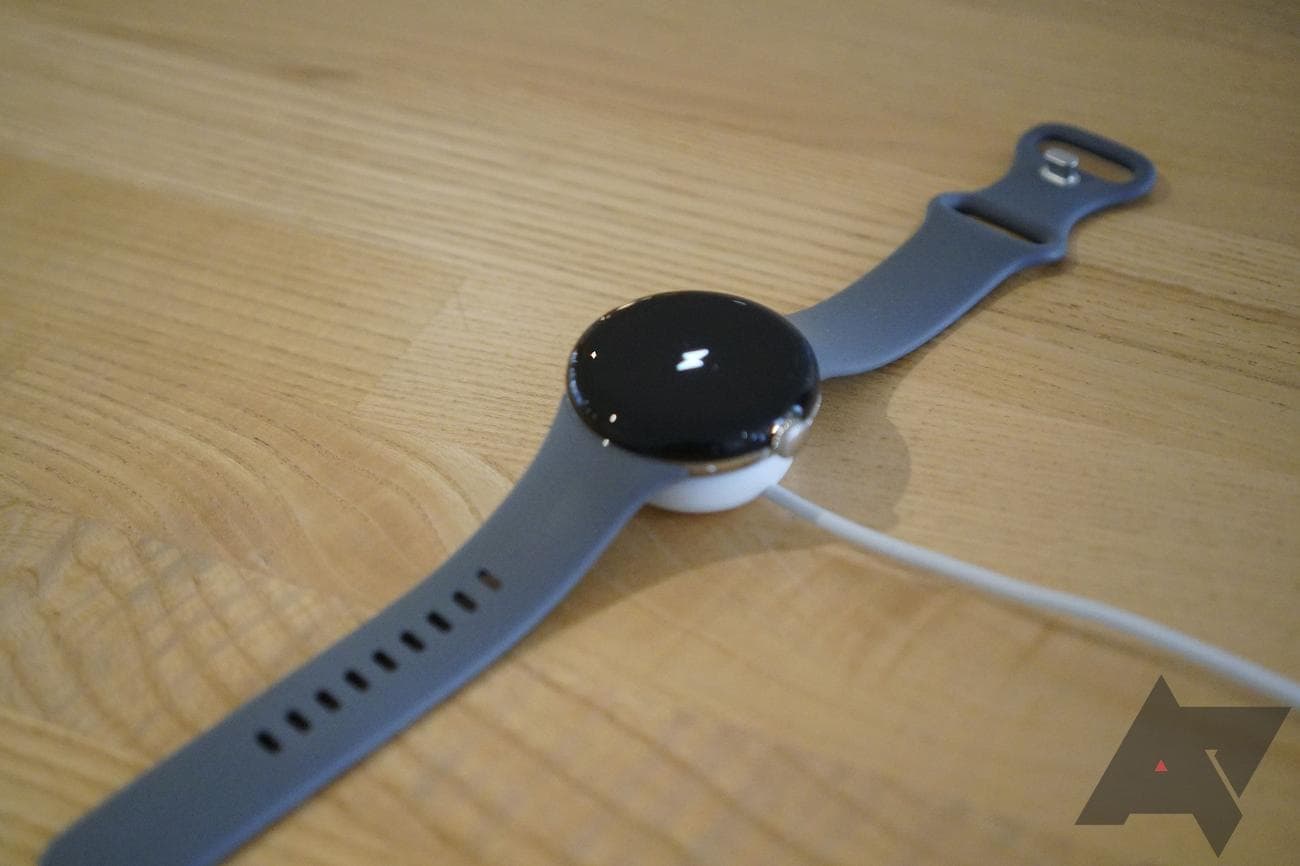
As with price, this is another category where it’s objectively a win for Samsung. While it’s struggling to match the impressive stamina its wearables managed when using its own Tizen operating system, Samsung has made some progress on battery life with Wear OS. Both the 40mm (284mAh) and 44mm (410mAh) Galaxy Watch 5 wearables have 13% larger batteries than the previous generation.
To be clear, you’re still not going to get days of life out of either. In our Samsung Galaxy Watch 5 review, we managed around 24 to 36 hours worth of battery on the smaller, 40mm model. And while Samsung says you’ll get up to 50 hours on the 44mm version, anecdotally, people are claiming it falls some way short of that thanks to its larger screen. In other words, expect 1.5 days, and accept anything extra as a bonus.
But as meager as that is, it’s still better than what the 294mAh cell on the Google Pixel Watch provides. Google says that a full charge will last up to 24 hours, and we found that mixed-use on the 4G model takes about 15% of the battery per hour.
There are ways to extend stamina on both, such as reducing brightness and turning off the always-on display, but ultimately neither watch is exactly a champion in the stamina department, especially if you lean heavily on the GPS-backed fitness features. Still, if battery life is a deciding factor, then you’ll want to go with Samsung.
Which is right for you?
Both the Samsung Galaxy Watch 5 and Google Pixel Watch offer an excellent smartwatch experience. But with different strengths and weaknesses for both, you can at least prioritize what’s important for you and buy accordingly.
The Samsung Galaxy Watch 5 isn’t exactly slacking when it comes to looks and features, and it’s had two objective wins over the Pixel Watch from the very beginning: battery life and price — and the second of these is even more of a gap now that the Galaxy Watch 6 has pushed the price of last year’s models down by up to $100.
Bluntly, the Galaxy Watch 5 offers significantly better value, with the larger 44mm model with LTE now retailing for up to $90 less than the basic Bluetooth Pixel Watch. Ultimately, that makes it the better wearable on paper, and it’s unbeatable if you’re looking for a great smartwatch on a budget.
Source: Samsung
Samsung Galaxy Watch 5
Best overall
A quality smartwatch with plenty of value for money
The Samsung Galaxy Watch 5 is a solid refinement of an already winning formula. It’s stylish, performs well, and outdoes the Pixel Watch on battery life while still undercutting it on price.
The Pixel Watch is the choice for people who want a distinctive-looking wearable and a model of what Wear OS can do. Like the Pixel phone series, the Pixel Watch is a showcase for Google’s operating system, and it really shows. While some Galaxy Watch 5 features are exclusive to Galaxy phone owners, the Pixel Watch works flawlessly with any
Android
device.
Source: Google
Google Pixel Watch
Runner up
A solid first attempt from Google
$295
$350
Save $55
The Pixel Watch is a strong first attempt from Google, but it’s let down by weak battery life and a high cost of entry that can’t compete with Samsung’s more established offering.