Best handheld gaming PC in 2024
Having the
best handheld gaming PC
gives you the power to play full-sized games wherever you are. The first handhelds may have been a bit slow and clunky, but mobile processing technology has improved so rapidly in the last few years that handhelds are now portable powerhouses in their own right.
Unlike the best gaming PCs, handheld PCs can be carried anywhere. Valve ignited the handheld PC space with the release of the Steam Deck in 2022, and rivals like the Asus ROG Ally and Lenovo Legion Go have since launched to give you an array of powerful options.
While testing the handhelds in this guide, we’ve looked at specs, build quality, and general usability. Software is a consideration, too. The Steam Deck runs on a Linux-based operating system called SteamOS and you add games from Valve’s official store, but most of the best handheld gaming PCs here use Windows. Valve OS is more streamlined but more restrictive, while Windows gives you more options but can be fiddly to use on a small touchscreen. Overall, it’s down to personal preference.
If you’re all work
and
play then the
GPD Win Max 2
and its novel convertible design has a unique pairing of a controller and traditional laptop design. If size is your main concern, the
Aya Neo Air
offers a minuscule footprint and a vibrant OLED display. Read on to find the best handheld gaming PC for your hands.
Why you can trust our advice ✔
At PCGamesN, our experts spend hours testing hardware, games, and VPNs. We share honest, unbiased opinions to help you buy the best. Find out how we test.
Best handheld gaming PCs in 2024:
-
Steam Deck OLED
– best overall -
Steam Deck
– best value -
Asus ROG Ally
– best overall -
Lenovo Legion Go
– best screen -
GPD Win Max 2
– best convertible option -
Aya Neo Air
– most portable option -
GPD Win 4
– premium choice -
Razer Edge
– best cloud/mobile hybrid
1. Steam Deck OLED
The best handheld gaming PC overall
Steam Deck OLED specifications:
| APU | AMD Zen 2 |
| Cores | 4 |
| Threads | 8 |
| Graphics | AMD RDNA 2 (8 CUs) |
| RAM | 16GB LPDDR5 (6,400MT/s) |
| Display | 7.4-inch OLED (1280 x 800 / 90Hz / HDR) |
| Storage | 512GB NVMe SSD, 1TB NVMe SSD |
| Weight | 640g |
| OS | SteamOS |
Pros
- OLED screen is stunning
- Better battery life
- Runs quietly and stays cool
Cons
- APU performance is unchanged
- Not available with less than 512GB storage
- SteamOS still has annoying quirks
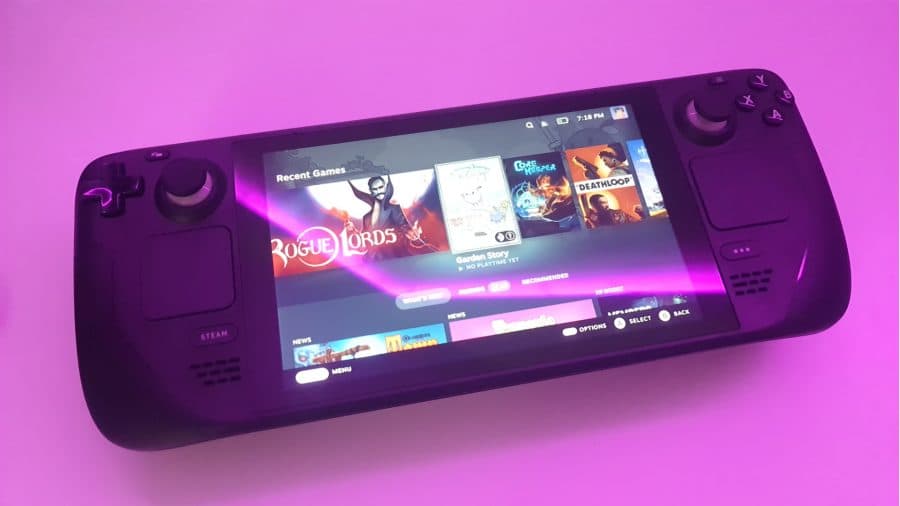
Valve has realized the full potential of its handheld with the Steam Deck OLED. The screen is bigger, brighter, and better than the original Deck in our number two spot, but the refresh is far more than meets the eye.
You get improvements to battery life for longer gaming sessions, a weight reduction for greater comfort, plus Wi-Fi for quicker downloads. The Steam Deck OLED is the best on-ramp for handheld PC gaming there is, with a few downsides. The APU inside the OLED is almost identical to the original Deck, save for efficiency, and that places the handheld significantly behind the curve in terms of power. Simply put, some triple AAA releases will be out of reach to you.
If you’re looking for a well-priced handheld with a stunning display and access to your Steam library on the go, the Steam Deck OLED is the top choice.
Read our Steam Deck OLED review.
2. Steam Deck
Best value handheld gaming PC.
Steam Deck specifications:
| APU | AMD Van Gogh |
| Cores | 4 |
| Threads | 8 |
| Graphics | 8 RDNA 2 CUs |
| RAM | 16GB LPDDR5 5500 MT/s quad channel |
| Display | 7-inch IPS 800p/40-60Hz (fixed) |
| Storage | 64GB eMMC, 256GB or 512GB PCIe 3.0 SSD |
| Weight | 669g |
| OS | SteamOS |
Pros
- Unmatched price-to-performance
- Huge aftermarket ecosystem
- SteamOS
Cons
- Lackluster screen
- Game compatibility
- Verification program isn’t always correct
The Steam Deck wasn’t the first handheld gaming PC, but it’s certainly been the most successful. It gives you seamless integration with Steam and a console-like experience means it can be as plug-and-play as you like – with the benefit of having a completely user-tweakable OS under the hood.
The lower-end 64GB model is now discontinued, but for now, you can still pick it up from retailers like Amazon, expand the storage, and pair it with the best Steam Deck accessories to bring it up to a usable capacity.
Titles such as
Starfield
, Star Wars Jedi: Survivor, and Remnant 2 cause the Steam Deck to misstep. Whilst we’re a little away from all major AAA releases being unplayable, the clock is ticking and you may feel you get more value if you opt for something a little newer.
The custom APU dubbed Van Gogh is still powerful enough for most games and if you mainly want to play through retro games, 2D games, sidescrollers, or emulated titles then you will be more than happy with the performance. This is still a great-value handheld gaming PC.
3. Asus ROG Ally
Best Windows option.
Asus ROG Ally specifications:
| APU | AMD Ryzen Z1 Extreme |
| Cores | 8 |
| Threads | 16 |
| Graphics | 12 RDNA 3 CUs |
| RAM | 16GB LPDDR5 6400 MT/s dual channel |
| Display | 7-inch IPS 1080p/120Hz VRR |
| Storage | 512GB PCIe 4.0 SSD / microSD |
| Weight | 608g |
| OS | Windows 11 |
Pros
- 120Hz VRR display
- Fast Ryzen Z1 chip
- Big company backing
Cons
- MicroSD card overheating
- Armory Crate isn’t as good as SteamOS
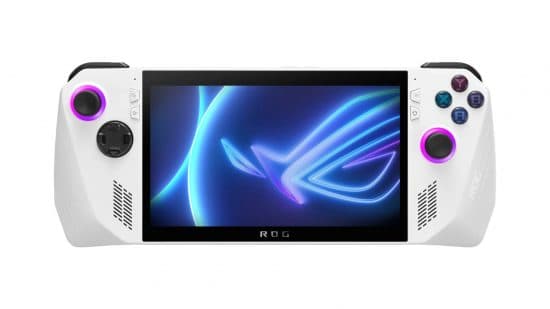
The amount Asus charges for its ROG Ally is a pittance compared to what smaller production-run companies such as OneXplayer, GPD or Aya Neo offer up, and whilst they cook up their own Zen 4-based handhelds, the ROG Ally stands head and shoulders above them.
The Z1 Extreme chip is enough to power most of the latest and greatest PC games, including Starfield mods designed to enhance the game’s performance.
The VRR display will greatly increase consistency when gaming too, with no screentearing. This means that you won’t have to stress about reaching a specific target like you have to with the Steam Deck. You can enhance the experience further by pairing it with the best Asus ROG Ally accessories.
Armory Crate also isn’t the best handheld interface. Going in and using it can be a little clunky at the best of times, especially in the early days. Fortunately, you can just set up Steam Big Picture mode to initiate on launch and you will essentially have a very close experience to the Steam Deck – just without precompiled shader compilations.
The souped-up hardware and great build quality land it a place in our guide. If you love playing modern titles in particular, the Asus ROG Ally’s spec put it in a position to outlast the Steam Deck.
Read our Asus ROG Ally review.

4. Lenovo Legion Go
Best handheld with a big screen
Lenovo Legion Go specifications:
| CPU | AMD Ryzen Z1 Extreme (8 cores / 16 threads) |
| GPU | AMD RDNA 3 (12 CUs) |
| RAM | 16GB LPDDR5X (7,500MHz) |
| Display | 8.8-inch IPS (2560 x 1600 /144Hz) |
| Battery | 49.2WHr |
| Storage | Up to 1TB NVMe SSD |
| Weight | 854 / 640g (with controllers detached) |
| Size (W x D x H) | 298.83 x 131 x 40.7mm |
Pros
- Massive 8.8-inch screen
- Detachable controllers
- Great handheld performance
Cons
- 1600p is generally too high for GPU
- Heavy
- Fiddly software experience
With its 8.8-inch display, the Lenovo Legion Go is the handheld for you if you want a big-screen experience. While its size naturally helps with immersion, it’s also responsive, sharp, and vivid. With a native resolution of 2560 x 1600 and a refresh rate of 144Hz, the IPS panel is about as good as it gets for an LCD handheld.
There’s some powerful hardware too. The AMD Ryzen Z1 Extreme chipset makes the Legion Go one of the most powerful handhelds around, but it’s also one of the most versatile thanks to the detachable controllers and kickstand, which give you a unique experience, especially in ‘FPS Mode’.
The Legion Go does have a few flaws. It’s much heavier than its competitors, weighing in at 854g, which can make using it for long periods a bit tiring. You’ll also need to tinker with settings and resolution fairly frequently, as 1600p can be too demanding for the Ryzen Z1 Extreme APU in many cases, and the software can be fiddly.
Read our Lenovo Legion Go review.

5. GPD Win Max 2
Best convertible handheld gaming PC.
GPD Win Max 2 specifications:
| APU | AMD Ryzen 7 6800U |
| Cores | 8 |
| Threads | 16 |
| Graphics | 12 RDNA 3 CUs |
| RAM | 16GB LPDDR5 6400 MT/s dual channel |
| Display | 10.1-inch IPS 2560 x 1600 |
| Storage | 1TB PCIe 4.0 SSD / microSD |
| Weight | 1005g |
| OS | Windows 11 |
Pros
- Essentially a laptop
- Elevated eye position
- Great keyboard
Cons
When you have work at 9 but emulation at 5. The GPD Win Max 2 is kind of the mullet of the gaming handheld PC world – business up front and party at the back. What makes this diminutive netbook a handheld gaming PC is the inclusion of the joystick and triggers. Furthering its credentials is the fact the joysticks use Hall Sensors so that you need never worry about stick-drift.
The shockingly useable keyboard is great for productivity tasks if you need the absolute smallest laptop on the go but it’s also great to have when text prompts appear in games or you like a lot of hotkeys. The 2560 x 1600 screen is very sharp too – just not quite as crispy as the OneXPlayer 2’s – so games and text will be very easy on the eye.
With the addition of a keyboard however, comes extra weight and the GPD Win Max 2 weighs a whopping 2.22lbs (1005g) so you might need to pump iron to comfortably hold it for longer than five minutes. To make up for this weight – your pockets will be markedly lighter as the GPD Win Max 2 costs a pretty penny.
Like other smaller manufacturers on this list, GPD may not have the production of scale to keep costs down but they have been in the business longer than anyone else with the original GPD Win debuting in 2016 and this expertise shines through in their products.
6. Aya Neo Air
Best portable handheld gaming PC.
Aya Neo Air specifications:
| APU | AMD Ryzen 5 5560 |
| Cores | 6 |
| Threads | 12 |
| Graphics | 7 Vega 7 CUs |
| RAM | 16GB LPDDR4 4266 MT/s dual channel |
| Display | 5.5-inch OLED 1920×1080 |
| Storage | 512GB PCIe 4.0 SSD / microSD |
| Weight | 398g |
| OS | Windows 11 |
Pros
- Extremely light and portable
- Gorgeous OLED
- Hall Effect joystick and triggers
Cons
- Underpowered
- No suspend feature
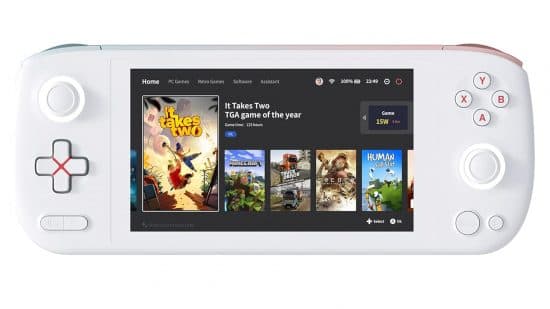
The Aya Neo is a very slick and svelte package that isn’t as astonishingly expensive as some of the other non-Valve/Asus entries on our list today. It has an excellent OLED display that allows for great contrast levels with true blacks and bright highlights making for a very vibrant and punchy image.
OLEDs have very good image persistence too so there will be no visible ghosting and input delays will be kept to a minimum given the very fast response time. Its pint-like statute means it will easily be stowed away in your bag and playing it on the go is far more practical than say with the comparatively monstrous Steam Deck.
The Steam Deck’s ace up its sleeve, however, is its suspend feature which allows you to pick up from where you left off, something that is sorely missed here given how convenient the Aye Neo Air is.
Another letdown is what’s powering the device under the hood. The Ryzen 5 5560U. This unfortunately doesn’t hold a candle to the RNDA 2 and RDNA 3-derived APUs powering the rest of our roundup.
This limits the Air to less processing intense games, but that still covers a lot of ground. 2D-pixel games particularly shine on the OLED panel, for example. That may well be more than enough for you – especially when combined with its smallness.

7. GPD Win 4
Most premium gaming handheld PC.
GPD Win 4 specs:
| APU | AMD Ryzen 7 6800U |
| Cores | 8 |
| Threads | 16 |
| Graphics | 12 RNDA 2 CUs |
| RAM | 32GB LPDDR5 6400 MT/s dual channel |
| Display | 6.1-inch IPS 1920×1080 |
| Storage | 1TB PCIe 4.0 SSD / microSD |
| Weight | 598g |
| OS | Windows 11 |
Pros
- Slick PSP-like design
- Sliding screen
Cons
- Cramped controls
- Expensive
Sony’s PSP is arguably one of the best-designed pieces of tech ever conceived and it’s clear GPD is of this persuasion as it seems they took everything great about that and improved the controls and added a keyboard hidden underneath a sliding screen.
Whilst being a similar price to other handhelds, this novel construction and quality design make it our pick for the most premium handheld gaming PC. Whilst the screen doesn’t slide up that much, it makes a noticeable difference and your neck will thank you if you play it for any length of time.
The keyboard is not the most ideal typing experience but it’s surprisingly useable. It also blows the Steam Deck and ROG Ally’s touch keyboard out of the water. Powering the GPD Win Max 2 is the Ryzen 6800U, a very performant APU that will see more recent titles ticking along despite it not being the latest and greatest.
By taking inspiration from the PSP though, the controls can only be improved by so much and they are still more cramped and uncomfortable than most of the other entries in this list. It is of course rather expensive, but if you are a PSP purist, that may be a small price to pay.
8. Razer Edge
The best for cloud gaming.
Razer Edge specifications:
| Processor | Snapdragon GX3 Gen 1 |
| Display | 6.4 inch FHD AMOLEND, 144Hz |
| RAM | 6GB LPDDR5 |
| Storage | 128GB – Expandable up to 2TB |
| Battery | 5,000mAh |
| Available in | Wi-Fi & 4G models – Black only |
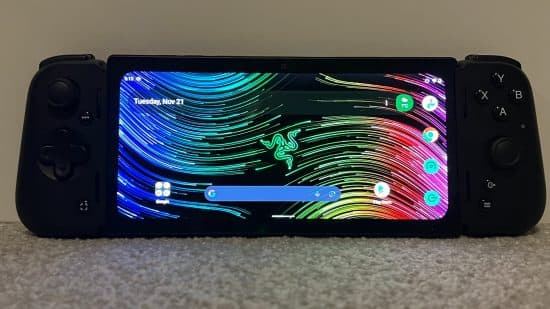
While not a PC gaming handheld in the traditional sense, the Razer Edge gives you access to your PC library via cloud streaming. You can link your Game Pass, GeForce Now, and Steam accounts to stream games from anywhere and the Edge does it all with a stunning display and plenty of power to back it up.
Mobile games are also a breeze thanks to the Andriod OS, giving you the option to run games natively with its 128GB storage. When we reviewed the Razer Edge, we found the cloud streaming setup to have one notable flaw with its resolution output, but beyond that, it was a fantastic device with plenty of room to grow in the future.
Nexus is the trick that the Edge has up its sleeve, as it allows you to completely remap the button inputs to the included Razer Kishi V2 controller. You can then make these overlays disappear, leaving your gaming experience uninterrupted. This software is only for mobile titles though, as PC cloudy streaming supports the Razer Kishi V2 as though it was a standard Xbox controller.
Read our Razer Edge review.
How to choose the best handheld gaming PC
When looking for a handheld gaming PC, you should consider portability, price, screen size, and type. All of the handheld options here can be carried away, but sizes vary somewhat; the Aya Neo Air is under 400g, while the Steam Deck is around 640g. Do you want something to curl up on the sofa with? Or something you can easily bring with you when you’re out and about? Something like the Steam Deck or the Asus ROG Ally will be a little too big, but a smaller model like the Aya Neo Air will be much better suited to the task.
Are handheld gaming PCs good?
Handheld gaming PCs are great if you want a portable gaming experience. They might be slightly less enjoyable to use for games that have been specifically designed with a gaming keyboard and mouse, but that’s just a small slither of the PC gaming pie.
Is Steam Deck the best handheld PC?
We’ve put the Steam Deck OLED as the best handheld gaming PC in our guide for several reasons. It’s got a dazzling 7.4-inch OLED display, an enormous games library with SteamOS, and it remains more affordable than rivals.
That doesn’t mean that the Steam Deck handheld PC is the best for
you
, though. If you’d rather get a device that runs on the Windows 11 operating system, or want something more portable, we recommend reading the full reviews of the other handheld gaming PCs on our list.
What is the most powerful handheld gaming PC?
It’s a close tie between the Asus ROG Ally with the AMD Ryzen Z1 Extreme and the Ayaneo 2S (which we hope to review soon). Both offer best-in-class processing power and should have no problem playing new triple-A games. Of course, you’ll pay for this processing power with a higher price tag.
If a handheld gaming PC isn’t the best fit for you, the best mini gaming PC will offer you another compact desktop format. Find out how to build a gaming PC and you’ll have the ideal setup in no time.
VIA:
.pcgamesn.com