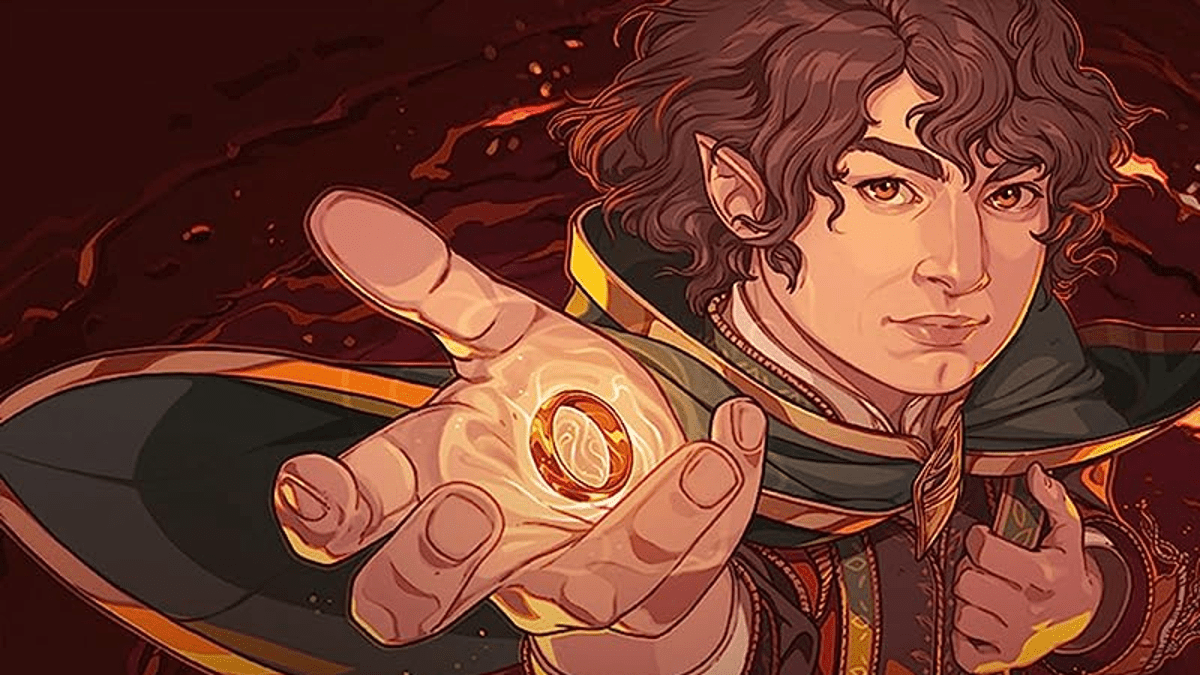
Lord of the Rings Tales of Middle-earth—Beginner Guide to Magic
Related Posts
Today Wizards of the Coast launched one of the biggest external collaborations it has ever done with
Magic: The Gathering
—
Tales of Middle-
earth
, an entire expansion dedicated to the world of
Tolkien’s beloved fantasy works
. If you’re a
Lord of the Rings
fan
intrigued by
all the gorgeous art
, but a
Magic
neophyte, we have you covered.
What Is
Magic the Gathering: Tales of Middle-earth
?
Tales of Middle-earth
is the first major release of its scope in a
Magic: The Gathering
sub-theme
called
Universes Beyond
. Created after Wizards of the Coast did a similar collaborative set for
Magic
with
Dungeons & Dragons
called
Adventures in the Forgotten Realms
(and a smaller follow up,
The Battle for Baldur’s Gate
),
Universes Beyond
is now the official home for any external collaboration Wizards does for
Magic
.
There have been a few releases so far—special cards for Wizard’s “Secret Lair” drop collection have collaborated with the likes of
Fortnite
and
The Walking Dead
;
there have also been decks for
Magic
‘s Commander format (more on that later) for
Warhammer 40,000
, and upcoming products include
Doctor Who
,
Final Fantasy
, and more. But
Tales from Middle-earth
is definitely the biggest so far—with 281 cards, it’s on par with a traditional
Magic
expansion, and comes released in a bunch of product types that can be a little daunting for
Magic
newcomers.
:
Wizards of the Coast
Where to Start With
Tales of Middle-earth
Extremely good news for those newcomers though: if you just want to get started with
Magic
, literally begin
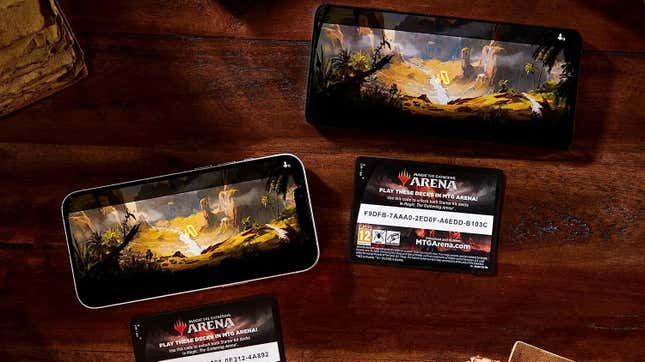
with the Starter set! This is a two-deck bundle that costs around $20, and comes with a how-to-play guide—as both a physical booklet and access to an online interactive tutorial—boxes to keep them in, and even two sets of codes so you and a friend can unlock both decks in
Magic The Gathering: Arena
, the mobile/PC digital version of the game.
The two included decks are naturally themed around the forces of g
ood and e
vil seen in
Lord of the Rings
: one including iconic heroes such as Aragorn and Arwen, Galadriel and Gandalf, and of course a hobbit or two, and the other helmed by cards themed around Sauron and his agents, and the sinister orc armies of Mordor. As a
LOTR
fan, you’ll get a nice, contained way to learn and play
Magic
, and
explore the theming you’re interested in—
a
nd if that’s all you want to do, you can leave it t
here.
:
Wizards of the Coast
Next Steps: Collecting the Set
But! Perhaps you’ve seen all that pretty artwork and gone a bit Gollum. What if we wants more, precious? Your
Magic
/
Lord of the Rings
journey can go one of two ways after the starter set: either you try to chase as many cards in
Tales of Middle-earth
as possible, or you try to dig deeper into
Magic
yourself and start using the cards you’ve acquired to build your own decks.
Let’s start with a purely collecting standpoint first. Every
Magic
set,
Tales of Middle-earth
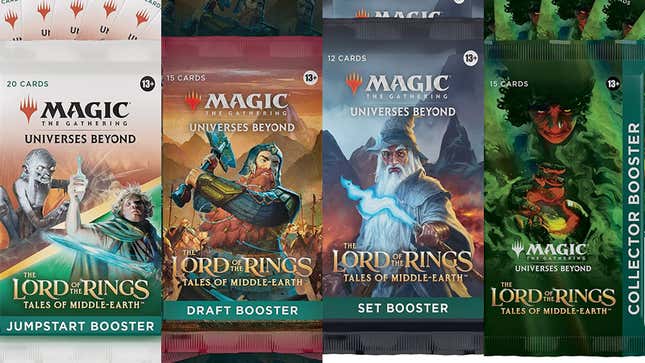
included, spreads its cards across a variety of booster packs:
-
Jumpstart Boosters:
These 20-card packs are designed for super quick deck construction: you buy two, shuffle them together, and you have a reasonably viable deck to play against another opponent’s jumpstart deck. -
Draft Boosters:
These are usually aimed at people more experienced with
Magic
, who don’t necessarily care about a chance at rare versions of cards in the set but just need raw options to build and tweak their decks. There’s 15 cards in each pack, and while they’re intended to be aimed at experienced deck builders, you can still buy them as a way to round out your own collection. -
Set Boosters:
Set Boosters are almost identical to Draft Boosters, but they have fewer cards (12 per pack), tend to cost slightly more, and also have more guaranteed chances at rare cards and alternative art variants. If you’re not looking to chase the full set and just want some nice
Lord of the Rings
cards, these are a good option. -
Collector Boosters:
The last and most expensive option, but… hang on, hear us out.
You Don’t Need to Buy Collector Boosters, Especially for
Tales of Middle-earth
Collector Boosters were introduced to
Magic
in 2019, and are essentially a mirror to Draft Boosters but for, well, people who want to collect the rare cards and art variants in a set. There’s 15 cards in a pack, and while they were introduced at costing an already-
pretty-high $13, more often than not they now retail for $20-25 per pack (Wizards removed MSRP standards from
Magic
sets
just one month
after it introduced Collector Boosters. Do with that information what you will).
Why the high price? Because Collector Boosters have a much, much higher ratio of rarer cards and special variants in them. A single booster is made up of roughly two thirds of cards of the “uncommon” rarity or higher, guaranteed foil versions, and at least one special “Full Art” card, designed to be combined with others to create a larger picture. They’re a sure-fire way to spend a lot of money in a short amount of time if you’re trying to chase cards, but for
Tales of Middle-earth
in particular, they’re even more of a headache at the moment.
Tales of Middle-earth
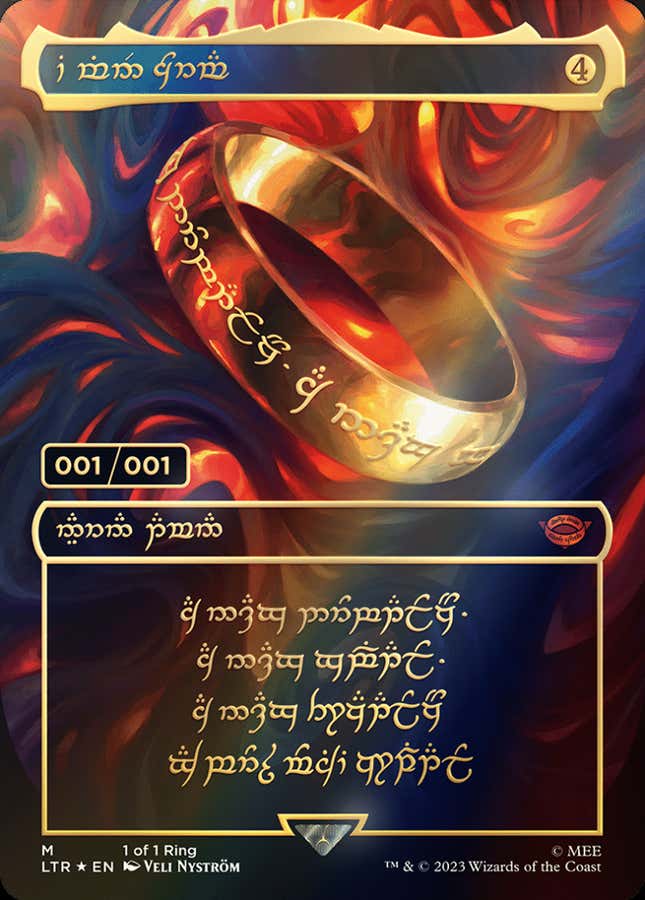
Collector Boosters are the only way to find several of the rarest cards in the set: special, numbered “Serialized” versions of the Human, Elvish, and Dwarven rings of power. While these cards exist in other forms throughout the set, these limited numbered cards are extremely rare.
:
Wizards of the Coast
And of course, this is
Lord of the Rings
, so another was forged in secret: there is a special variant of the One Ring in
Tales of Middle-earth
Collectors Boosters of which there is only
one
in the entire world. A chance at this ultimate card has sent aftermarket prices on Collector Boosters skyrocketing by the bucketload—as of right now,
a box of 12 boosters is going
for almost
$450
on
Amazon
—as collectors and hobby shops offer high-price bounties to anyone willing to give them the card, if they find it. There’s a parallel here between capitalism and the temptations of Sauron’s most evil creation, but hmm, I just can’t put my ring-finger on it.
Anyway, as a newcomer you absolutely do not need to focus on Collector Boosters as a way to get yourself some
Lord of the Rings
cards. Just like the One Ring itself, there is temptation in wanting guaranteed access to the shiniest of cards (in the foil variants’ cases, literally), but the bang for your brandybuck just isn’t worth it if you’re looking to actually build out a collection of cards. You can always buy one or two later down the line to chase alternate card art or other variants, but for now, resist. Pass the test, diminish, go into the West, and remain Galadriel, my friends.
Next Steps: Learning
Magic
If you want to use the
Lord of the Rings
hook to actually get into playing
Magic
rather than just collect these specific cards, there’s pros and cons. As a special collaboration set, while
Tales of Middle-earth
uses standard
Magic
rules and effects, the cards themselves are not intended to be played in standard play formats against most other
Magic
sets. For most people this won’t matter—you want to play with the
Lord of the Rings
cards against other people using
Lord of the Rings
cards, because it’s
Lord of the Rings
. And you can do that! But if you want to expand your
Magic
knowledge beyond Middle-earth, you’ll need to look to other card sets.
But that doesn’t mean you can’t build out your knowhow solely within
Tales of Middle-earth
cards. Beyond the Starter kit, we’ve already mentioned a few ways you can start building up a set of cards to build your own deck with: Jumpstart Boosters for quick-and-easy randomized decks (although you will need to add land cards, the subset of
Magic
cards that provide the resources you need to play other cards, to get a viable deck), or draft boosters to give you more refined options. There’s also a special bundle pack for
Tales of Middle-Earth
available that includes eight
Set Boosters, some unique alternate art cards depicting Frodo, Sam, and Gollum’s struggle atop Mount Doom, 40 Land cards,
a special
life
counter, and then a box to keep all your cards in. After the Starter Set, this is a great way to expand your collection before you look at either tweaking those pre-constructed decks or using them to inspire your own deck creations.
:
Wizards of the Coast
Tales of Middle-earth
also has special releases for another format of
Magic
: Commander. Originally a fan-designed format that has in recent years become officially supported with products and tournaments, Commander is a 3-5 player format uses a much larger deck size—100 cards instead of 60—and focuses around the addition of a single specialized hero in your deck that acts as, well, the Commander.
Tales of Middle-earth
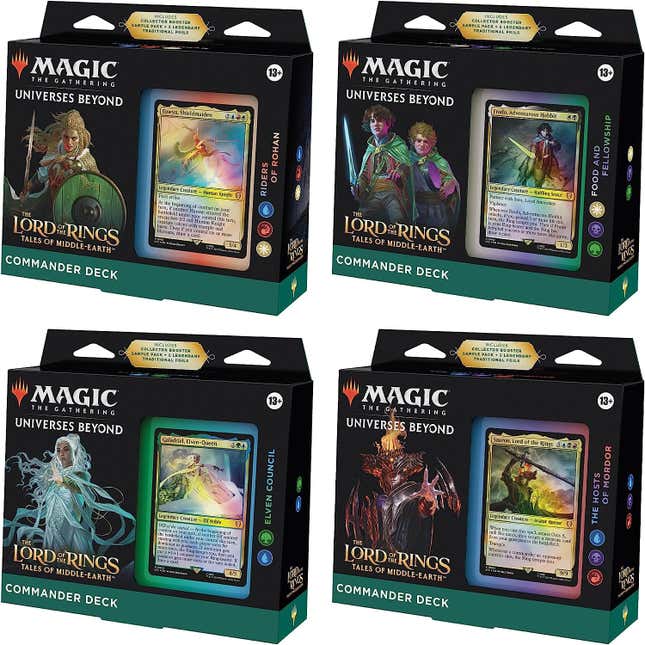
has four Commander Decks being released:
-
Food and Fellowship
, a h
obbit-themed deck built around Frodo and his halfling friends -
Elven Council
, featuring the elder races of Middle-earth and allies like Gandalf and other wizards -
Riders of Rohan
, a (duh) Rohirrim-themed deck focusing on Rohan, Gondor, and allies like Aragorn and Gimli -
The Hosts of Mordor
, a deck built around Sauron and evil denizens from across Middle-earth, from Shelob to the Balrog
Like the Starter set, each Commander Deck is ready to play, and comes with everything you need to learn the format, as well as a box for your deck. And if you’re interested in collecting the
Tales
cards too, you still have an incentive to pick them up: 20 of the cards in each deck are specific Commander cards that can only be found in them. A single deck usually costs around $40-$50.
:
Wizards of the Coast
Where Can I Play My
Tales of Middle-earth
Cards?
Tales of Middle-earth
is designed to be played in casual formats outside of
Magic
‘s “Standard” tournament format—which means you can’t throw down cards from it against up sets in the current rotation. It’s designed to played in the separate “Modern” (where contemporary cards from after
Magic
‘s 8th edition in 2003 can be used) and “Historic” or “Vintage” formats (which allows cards that are no longer available in Standard). The Commander decks mentioned above, of course, can only be played in Commander, although they do contain cards which you can use to build your own deck for other formats.
If you don’t have anyone you know who wants to play physically however, you have another option: the Starter Set includes code to unlock its digital equivalent in
Magic Arena
, and
Tales from Middle-earth
will be available both there and in
Magic Online
to purchase digitally as of this week. You don’t get a physical collection, sure, but you can play with people across the world!
Where to Go After
Tales of Middle-earth
If all you want is
Lord of the Rings
, your entirely expected journey can end here—although a few more special cards for
Tales of Middle-earth
are releasing later this year, if you’re just content to have this be your little corner of
Magic: The Gathering
‘s vast multiverse, everything above is all you need. But if you want to dip your toes into that multiverse, everything you learn about playing
Magic
with these cards will likewise apply to the majority of cards available in
Magic
‘s current standard rotation of cards. There’s new expansions coming out for the game at a
rapid
clip, so if you want to dive in—check out what’s available, buy some packs, build some decks, and get stuck in like Samwise Gamgee presented with some nice, lovely taters.
Want more io9 news? Check out when to expect the latest
Marvel
,
Star Wars
, and
Star Trek
releases, what’s next for the
DC Universe
on film and TV
, and everything you need to know about the future of
Doctor Who
.