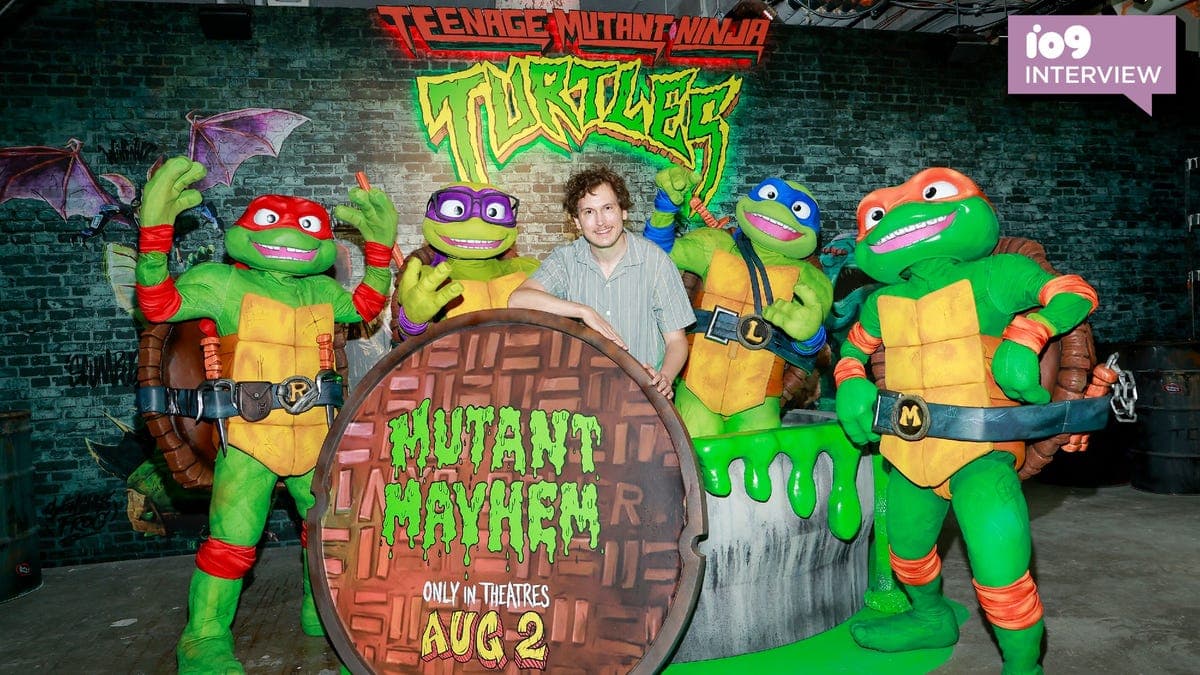
Ninja Turtles Interview: Jeff Rowe Talks TMNT: Mutant Mayhem
Watching trailers
for
Teenage Mutant Ninja Turtles: Mutant Mayhem
, one of the first things to come to mind is
Spider-Man: Into the Spider-Verse
.
Spider-Verse
was such a game changer in animation that
when you see
any animated movie after it that looks a little bit different, it’s very easy to link the two. Especially when
Turtles
is coming out the same summer as the sequel
Across the Spider-Verse
was released. You assume there’s a link.
Jeff Rowe understands that, and is honored by the comparison, but doesn’t exactly agree with it. The director of not just
Mutant Mayhem,
but also co-director of
The Mitchells vs. The Machines,
sees the link more as a sign that
animation has taken a new turn
in its history than anything else. In fact, Rowe didn’t even look at past
Ninja Turtles
movies for inspiration. Instead, he says it was
Netflix
‘s
The Toys That Made Us
that really gave him the most excitement when gearing up for the project.
As a long-time Turtles fan, Rowe connected more to the toys themselves than the movies or even the original animated series. He talked about that,
Spider-Verse
and so much more speaking to io9 recently. Rowe revealed the film was completely different in earlier iterations (
it had Shredder as the villain
), how difficult it was to get the incredible voice cast, the complex Turtles canon, and so much more. Check out our full interview below.
:
Jason Mendez
(
Getty Images
)
Germain Lussier, io9: Now, I know you were a huge Turtles fan growing up, so I’m sure you didn’t have to do too much research when you got the job. But I’m curious specifically about the previous movies. There are so many and they’re all so different. Did you rewatch them and what at all did you learn about them in terms of what you wanted to do and what you didn’t want to do?
Jeff Rowe:
I honestly did not. The thing that I watched that was most useful to me was that Netflix documentary [series]
The Toys That Made Us
. T
here is one specifically about the Ninja Turtles toys, and that was just like a conduit, portal, like straight back to my four-year-old self. I
t really reminded me of the franchise and the characters and especially how tactile it was for me—l
i
ke how much of my connection to it specifically came from the toys, a
nd
the hours I spent imagining worlds and playing with them. And then when I
got this job, I kind of deliberately did not want to
cloud
my take on it with too much of what had been done in the past.
I encouraged that for the team too; a
lot of people
worked on the team who had never seen anything from
Ninja Turtles
, and they’d be like, “Oh, should we watch the movies?” And I would say, “No.
Just come in and watch these other films instead and come into this with a fresh take.”
io9: Speaking of other films, this
trailer
has been playing in theaters, this summer especially, and
people have
seen
[
Mutant Mayhem
]
as almost like a disciple of the
Spider-Verse
movies. As if this movie might not exist if that didn’t happen. Would you say that’s accurate? And how often did that movie in that kind of style come up?
Rowe:
I mean, people bring it up a lot. More than I would like, I think. But
the original
Spider-Verse
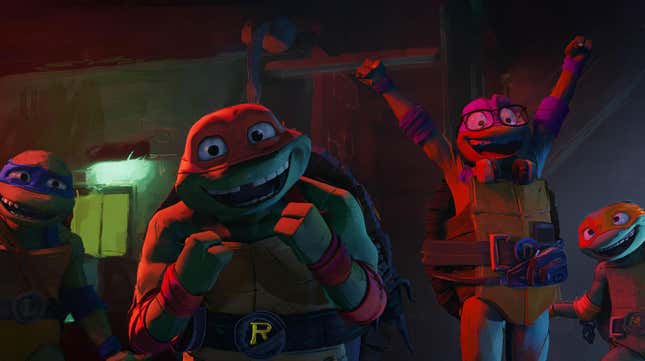
, I think, is one of the great works of art of the 21st century. And I will take as many comparisons as people want to give me to that. But they’re doing a very different thing. They’re very slick and polished and about precision. And our look and our style is a lot more lo-fi in a good way. We’re like the grunge bands in the ‘90s
. Just trying to do just
a very different thing.
But yeah,
I think it speaks to a thing that’s happening right now which is really exciting,
where
audiences don’t have the vocabulary yet because animation has been the same for 30 years and because it’s just been progressing on one track. Now that there’s like one different thing,
and then two and three and
four or five different things, the brain can only lump those together. I think hopefully in a couple of years time, people will be comparing things to
Mutant Mayhem
as much as they are to
The
Mitchells vs. the Machines
or
Puss in Boots
. And these disciples of
Spider-Verse
will hopefully create their own lineages.
:
Paramount
io9: Yeah. I agree. One of the many things I love about this movie is how it kind of balances this distinct ‘90s vibe for the original fans, but also tons of modern pop culture for teens and younger audiences. Was that part of the process early on or how did that kind of happen?
Rowe:
That came from, we did a unique thing on the movie, which is just recording all the kids together. Like it’s an audio nightmare. Movies don’t do it. But we recorded all the kids together and the way they talk to each other, often the things that they would say in between takes and when they weren’t doing scenes was so funny and so natural and so engaging that we wanted the movie to feel more like that. And we would throw away the script and encourage them to talk about something. “Talk about a video you saw on YouTube.” Relate about that because that’s how they naturally related to each other. And then we’d be like, “What do you want?” And one of them would be like, “I want to hang out with Drake.” And it’s like, “Okay, great, let’s put that in the movie because that’s authentic to you.”
io9: But also you use a lot of ‘90s music. Like “No Diggity” is one of my favorite songs and I was freaked out during that scene. I can’t wait to see that again. But then 4 Non-Blondes, Tracy Chapman—talk about the music choices and how you brought those in?
Rowe:
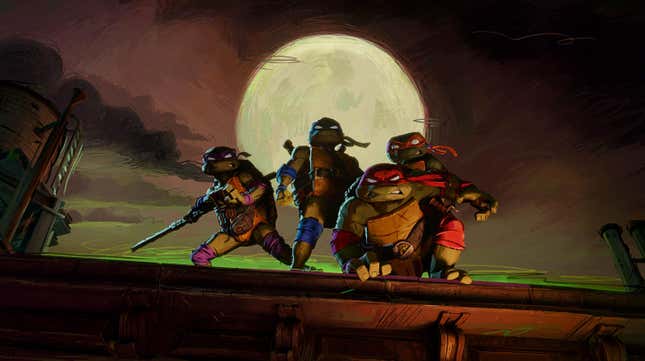
I was picking out a visual tone and style for the film very early on because we didn’t have a script yet. So I was just like making a mood board and I love the aesthetic of the late ‘80s
, early ‘90s
. The patterns, the colors. Spike Lee films. The music. New York hip-hop and underground club music of that era. It was a really exciting, optimistic time artistically. And the movie had to take place currently,
but my love of the Turtles is tied to this love of the ‘90s,
and it felt like a way to honor the history and maybe touch on some nostalgia without having them say
“Cowabunga” every five
minutes.
:
Paramount
io9: Now I’m not going to get into spoilers, but I thought so much of this story, the villains and especially where the story ends up in terms of the Turtles, was so unique to this franchise. I remember thinking “Whoa, I don’t think I’ve ever seen anything like this.” Am I right in assuming that, and how conscious of a decision was that to sort of make a story that uses the origin but goes into different places?
Rowe:
It was pretty conscious. One of the things we did early on is we would have these discussions,
and a lot of times we’d have to grapple with canon and then we’d be like, “Wait, what is the canon?” Splinter, in some versions, he’s a human who turned into a rat. And in other versions, he’s a rat who turned into a human because the ooze makes the last animal that you touch transfer… like we realized very early on that none of it makes sense because a lot of it was made up by toy companies or cartoons. Then we’re like, “Well, I think we have to do some grounding.” W
e want the film to be emotionally sharp and resonant and a lot of that comes from relatability. W
e need the audience to feel like they can see themselves in these turtles and feel like they’re on the same journey as them. And that can only happen if it feels like it takes place more or less in our world. That required a lot of just grounding to get it there. So yeah, very early on we’re like, “Well, we’re going to have to change some things from canon and some people might take exception to that, but hopefully they’ll
see what we did and understand why we did it,
and appreciate the end result.”
io9:
Oh, absolutely. Like I said, I think it works great. So this movie is called
Mutant Mayhem
.
So the villains here are all these mutants. It’s one of the first Turtle things not to have Shredder as the villain. How early on was the decision made to be like “Let’s not use Shredder at all in this?”
Rowe:
It came late. T
he early version of the film [was] very different from what you’re seeing on screen. It’s like,
they were just in high school the entire movie. Shredder was the villain. And then part of the process of making this—
and that’s one of the amazing things about animation,
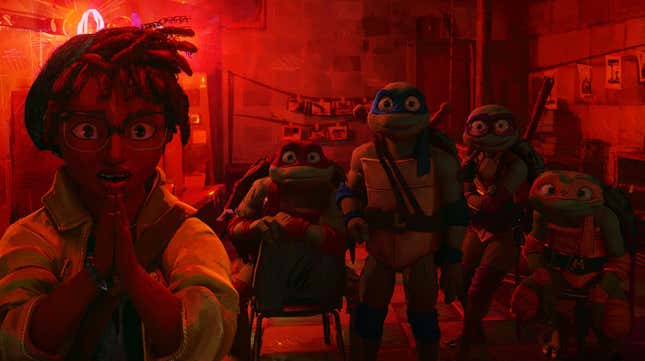
is because you don’t have to do a live-action shoot on a compressed schedule, you have a lot of time to make decisions and make sure that you’re making the best decision. And we dropped some of that out. Maybe halfway through we’re like “It can’t be Shredder. He’s a human. It’s too much, too soon. He’s too big of a presence.” For this story about the Turtles being accepted and finding a place in the world, it would really make sense and it would really help the story if the villain was a mutant like they are, with a similar back
story and [who could maybe be able to have a conversation with Splinter about like, “Look, we both hate humans. You go about it this way, I’m just going about it this way.” And we’re like, “That’s what this movie needs.” Hence Superfly and also deviating from the Baxter Stockman canon to create that character.
:
Paramount
io9: Now Shredder isn’t the only big
Turtles
thing you hold back here. We don’t get Casey Jones, Krang, about a million other things. Was that hard? I mean, obviously if you made a sequel, you could use more things, but a sequel is never guaranteed. Was it hard not to use every toy in the toy box—
almost literally, in this case—
for the first movie
?
Rowe:
There [
was a]
point where we were like, “This is coming together pretty good. We’re liking what we’re making. We’re not blowing it. We’re not whiffing it.” So likely, based on the importance of this IP to Paramount, we will likely be making a sequel or have the opportunity to explore more things later. And it wasn’t confirmed and it’s still not confirmed. [
Note
:
It has since been confirmed.
] But, you know, I think I think everybody wants to spend more time with these characters and I think there’s a lot of things in the lore that we haven’t been able to address yet.
io9: I think one of the other reasons why the movie works so well is obviously the Turtles have a great arc, but Splinter and April also have incredible arcs in this movie. So talk about the difficulty in balancing those characters, having nice, full, rewarding arcs with also the Turtles.
Rowe:
Yeah, I mean, we kind of just went in order. We’re like, “Well, okay, let’s just make sure the Turtles have like a good, satisfying arc.” And then if we can, there’s this great family story in here about the relationship with Splinter, and it seems like he should probably arc, too. That actually helps
them
arc. Okay, great. That fits in there. And then April’s a human,
and by giving ourselves space to just focus on the Turtles, I think it then presented organic opportunities to insert April and Splinter into that story. T
he more we were able to turn things to just be about acceptance, the more pieces started clicking together.
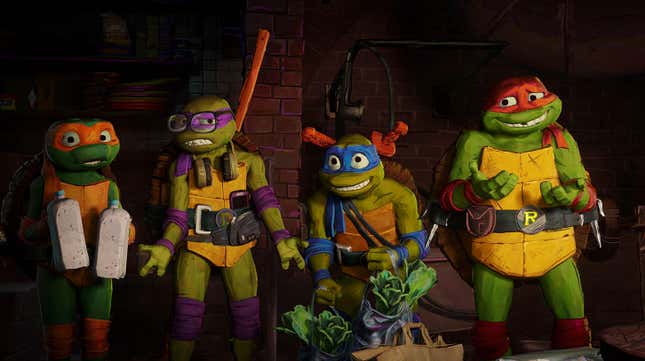
handed.
:
Paramount
io9: Beyond the teenagers, the voice cast in this is like a who’s who of incredible people. Was it difficult to assemble them or did you get your top choice in every role? How did that work?
Rowe:
Well, that’s the nice thing about doing a Seth Rogen movie. He just knows everybody. If you’re
calling Jackie Chan and it’s like, “Hey, there’s this guy named Jeff Rowe, he co-directed this animated film you probably haven’t seen. Do you want to do that?” The answer would be “No.” But when it’s a Seth Rogen movie, people will sign up for it because he’s very talented and he has a great track record,
and people know that’s going to be a fun project to work on.
io9:
You mentioned Seth and Evan [Goldberg] who produced this. But you also worked with Phil Lord and Chris Miller too. They’re doing the
Spider-Verse
stuff now but you worked with them on
Mitchells
. Compare
and contrast them as
producing partners,
because they’re some of the best in the business and we’re going to be watching their movies for decades.
Rowe:
Yeah, I think they are more similar to each other than either party would care to admit about the other
[laughs].
But they’re very friendly. They know each other really well. And the thing that I love about both of those teams is that at the end of the day, they just care about making a good movie.
Seth is an A-list celebrity, right? He could phone this in, but he rolled his sleeves up and got in there and rewrote the script. Phil would [also] get in there and rewrite parts of
Mitchells
with us. They’re very involved,
and they’re so dedicated to wanting the end product to be good,
that they’re wonderful people to make movies with.
io9: That’s awesome. And this will be my last thing,
but there’s a really funny Marvel joke [in
Mayhem
] that a
udiences are going to love
. Was that something you guys wrote or something that the
kids came up with?
Rowe:
I think that was a Seth suggestion. That was something he suggested in the session and it didn’t make it into the script. And then we’re like, “
Oh, he should say something like this.”
But that was something that came up in conversations a lot when we were like trying to explain the logic of [a scene], and Seth would use that as an example. “It’s like the Hulk in the diner in
Avengers
. People are taking selfies with him. That’s probably what they think.” And then when we got into the recording
session, we’re like, “They should just say that—t
he
y should just say that out loud, because they probably have the same reference point we do.”
Teenage Mutant Ninja Turtles: Mutant Mayhem
opens Wednesday, August 2.
Want more io9 news? Check out when to expect the latest
Marvel
,
Star Wars
, and
Star Trek
releases, what’s next for the
DC Universe
on film and TV
, and everything you need to know about the future of
Doctor Who
.