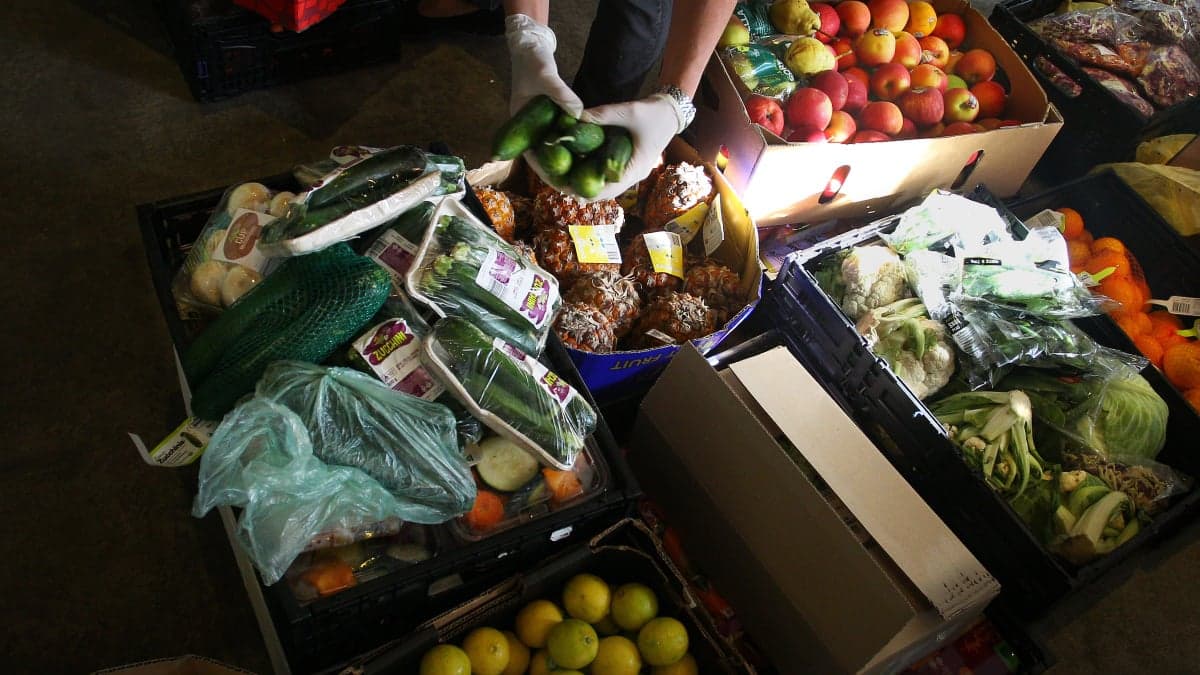
How to get involved in food rescue initiatives
We’ve all found ourselves clutching that lonely can of forgotten pantry beans, the last of an impulse bulk purchase at a warehouse club or a great sale at the grocery store. You might throw them in the trash or (hopefully) send them to your local food bank, alongside pasta, boxed mac and cheese, and other dry goods. And that’s probably where our understanding of food waste begins and ends.
But the
nationwide problem
of
excess food waste
, and the subsequent
movement
to
reduce and reallocate
our country’s excess, is much more complex.
Food
rescue
, or reallocation, is the umbrella term for a wide array of initiatives that seek to save food destined for landfills and redistribute it to those in need, with the hope of reducing environmental harm and curbing food insecurity. The movement goes beyond just efforts to donate food to those in need: It addresses overconsumption, encouraging people to donate what they’ve already grown or purchased, rather than adding more food into a system of waste.
SEE ALSO:
New congressional bill addresses food insecurity on the picket line
And the movement
operates across industries
, on multiple levels, addressing both larger-scale agricultural waste and smaller-scale household waste. Government programs encourage farms and businesses to donate food surpluses through government incentives. Food banks redistribute would-be waste to communities in need, and new tech ventures, like on-demand food donation apps, connect people to food on an individual basis.
The
U.S. Department of Agriculture
estimates that the United States wastes 133 billion pounds of food a year due to factors like issues during transportation, over-ordering by retail businesses, and household waste. Food waste (or “surplus”) makes up about
24 percent of what goes into American landfills
, with consumer-facing businesses creating 23 million tons of waste and households creating 30 million tons of waste each year, according to
ReFED
, a nonprofit that collects data on food waste across the United States.
Globally, 14 percent of food produced is lost between harvest and retail, while an estimated 17 percent of total global food production is wasted, the
United Nations reports
. That massive amount of food waste is associated with up to 10 percent of greenhouse emissions, according to another 2021
report
from the United Nations. “Reducing food waste would cut greenhouse gas emissions, slow the destruction of nature through land conversion and pollution, enhance the availability of food and thus reduce hunger and save money at a time of global recession,”
Inger Andersen, executive director of the UN Environment Programme (UNEP), said in a press release
at the time.
The USDA reports around
34 million Americans are food insecure
. In 2021, national hunger nonprofit
Feeding America
estimated that
more than 42 million people
faced food insecurity in the United States. And with the
expiration of pandemic safety net programs like emergency Supplemental Nutrition Assistance Program (SNAP) benefits
impacting millions of Americans, that’s a lot of hungry households that could be fed with the billions of pounds of food going to landfills.
Dr. Roni Neff, director of the Food System Sustainability and Public Health Program at Johns Hopkins Center for a Livable Future and associate professor at the Bloomberg School of Public Health, says the push to rescue food has grown over the last decade as the nation’s network of food pantries and food banks expanded, made clear during the pandemic. “There’s massive inequities in need, and that’s been shown during COVID-19 quite clearly,” Neff said. “I think that the ‘big bang for the buck’ is in larger scale processes, but there are really important ways that individuals can come into it.”
While food waste and food insecurity aren’t going to be eradicated purely by individual actions, Neff says, your choices can still help.
Here’s how you can take part in food rescue on almost every level, from donations to daily choices to reduce your waste:
1. Offer your uneaten food before it goes to waste
Traditional food banks are the most common, and often accessible, way to donate your unused food to those in need. Justin Block is the former managing director of Digital Platform Technology at hunger nonprofit
Feeding America
, a national organization working to end hunger through a system of nationwide food pantries and nutrition programs. It coordinates multi-level donations of would-be food waste from individuals, small businesses, and larger corporate donors through a program called
Meal Connect
.
Meal Connect supports food rescue on many levels. First, there’s mealconnect.org, an online platform for donors to post extra, available food to be claimed by food pantries around the country, Block explains. Meal Connect connects donors directly to individuals or transportation businesses that can pick up and deliver food to the closest participating food bank or food pantry. It also distributes larger amounts of food from restaurants, small businesses, and individuals to food vendors, soup kitchens, and food pantries, using volunteers trained to handle and transport food.
To donate food directly from your own kitchen, find your closest Feeding America food pantry. The organization has a searchable
database of local participating food banks
in your area. For food pantries outside the Feeding America network, check out
foodfinder.us
— an interactive virtual map of food pantries around the country.
Small business owners who would like to donate unused, excess food can
register for the Meal Connect program
.
Also check out other nonprofits attempting to reduce food waste through community-generated initiatives and creative tech:
-
Move For Hunger
teams up with businesses, licensed moving companies, and volunteers to transport unwanted food to local food banks, allowing businesses and individuals to curb their own waste and provide food to people in need. Founded in New Jersey, the organizations now operates in all 50 states and Canada. If you’re moving and need to get rid of pantry items, find a
registered food mover
on Move for Hunger’s website who will deliver your nonperishable food to your local food bank. -
Rescuing Leftover Cuisine
is a nonprofit focused on saving food surplus from food vendors and places like offices, dining halls, and restaurants. Through a digital network of volunteers, the organization coordinates food pickups and distribution across nine branches:
Atlanta, GA
,
Chicago, IL
,
Columbus, OH
,
Dallas, TX
,
Los Angeles, CA
,
Massachusetts
,
New Jersey
,
New York City
, and
Rhode Island
. You can
sign up to donate
your organization’s excess food online. -
Food Rescue US
‘ network of food donors, movers, community organizations, and food banks distribute food directly from donors to individuals in need in 24 states and the District of Columbia. You can
register
online to be a pickup and transport volunteer,
start a Food Rescue US location
in your area, or
contact a local chapter’s director
to become a donor. -
Food Rescue Hero
is a food rescue app, available on the
Apple Store
and
Google Play
, providing a platform for retail-based food rescue networks of food rescue and hunger relief nonprofits. The app serves 15 food rescue partners covering over 25 communities. -
Waste No Food
is a nonprofit online “marketplace” for businesses, farms, and nonprofits to connect in order to reduce and redistribute uneaten food. You can register as a
donor
yourself (primarily for business, farm, or grocery store owners), or
sign up as a volunteer
. Charities or nonprofit organizations are encouraged to
register
with Waste No Food to claim excess food through the organization’s online system. -
Ample Harvest
is a nonprofit that encourages individuals to reduce their food waste by donating excess produce from
home
and
larger-scale
gardening initiatives. Those interested in
either growing or donating already-grown food
can sign up online. You can also search for a
food pantry
near you.
Or you can go even more hyperlocal by donating your food directly to your neighbors. For example, community fridge programs — mutual aid initiatives where volunteers maintain publicly-accessible fridges open 24/7 — accept a wide array of food, both cooked and nonperishable. You can find a map of fridges near you on
Freedge.com
, an international nonprofit supporting community fridges around the world.
Each organization has its own guidelines for food safety and donations. But, broadly, Neff says that people are quick to throw out food
long before it’s actually bad
, and that’s adding to our waste problem. “It’s important to recognize that most date labels are not about food safety. They’re the manufacturer’s best estimate of when quality might decline, but it often is declining at an imperceptible amount,” Neff explains. The USDA’s
guide to food safety labels
explains that “best if used by” or “use by” dates — which typically aren’t required by federal law — are only indicators of a product’s quality, not food safety. Except for select products like baby formula, “if the date passes during home storage, a product should still be safe and wholesome if handled properly,” the USDA explains.
Additionally, many food businesses are now abiding by
voluntary industry guidelines
, Neff says. In these guidelines, “best if used by” is used to mark the quality date for the vast majority of foods (like the USDA explains). Where these guidelines diverge are with “use by” labels, which many grocers and food retailers are now using to mark a smaller portion of products where safety could be a concern if consumed after the date.
If you’re unsure, check with food rescue organizations for specific guidance on their donation protocols. Ample Harvest recommends using its
ProducePedia
to find nutritional and storage facts about various food items before donating.
2. Give your time and money to nonprofits and rescue initiatives
No food to offer? No worries. Neff says money and time make the biggest impact in reducing waste, helping organizations with their efforts in food rescue, environmental activism, and hunger relief to make wide-reaching, long-term change.
SEE ALSO:
Everything you should know about community fridges, from volunteering to starting your own
While donating money over food might seem a bit disconnected, or might not “feel as good as giving some concrete product,” Neff says, “the money can often go a much longer way.” Depending on the organization, monetary donations can also help build stronger food rescue networks, funding more transportation, storage facilities, or other operating costs needed to expand across the country. Donations also support political outreach for environmentally friendly policies, and can fund initiatives that provide educational resources to communities addressing food waste and insecurity, she says. Volunteering similarly helps organizations expand their capacity to collect and distribute mass amounts of food waste, explains Neff.
-
Consider
volunteering
with Feeding America to help Meal Connect’s work with participating, nearby food banks. Volunteers help sort and pack food, staff food pantries, and deliver meals directly to homes. -
Monetary
donations
to Ample Harvest can be made as single “eat once” contributions of a can or box food or as general contributions to
AmpleHarvest.org
“to create a sustainable and recurring opportunity for local growers to share their harvest with neighborhood food pantries.” You can also sponsor a
single food pantry
in your area. -
Move for Hunger operates off of
donations
to fund its transportation services, food drives, and more. Current donations go toward the organization’s efforts to address food insecurity caused by rising prices and cuts to SNAP benefits. According to the organization, a $25 donation provides enough resources to deliver 63 meals. You can also
volunteer
with the organization as a
mover
, join a
marathon fundraiser
, or
register
your community in the Move for Hunger network to facilitate neighborhood donations. -
Rescuing Leftover Cuisine needs
volunteers to transport
donations. The organization also accepts
monetary donations
that go towards the transportation and delivery of excess food. You can donate directly to a rescue branch in your area. -
Food Rescue US uses a robust volunteer network to help with food rescue across participating states, staff community kitchens reusing food surplus, and deliver meals directly to those in need. The organization also accepts
monetary donations
that go towards operating costs as well as food transportation. You can also donate directly to one of its local chapters from the same page. -
You can
donate
to the founding organization behind the Food Rescue Hero app,
412 Food Rescue
, which also delivers would-be food waste to a network of nonprofits battling food insecurity. Donations fund the organization’s transportation and delivery costs, as well as its
partner programs
, including a
monthly grocery subscription
that distributes “ugly” produce and a program that
turns salvaged food surplus into fresh meals
. -
To help Waste No Food’s mission, sign up as a transportation or outreach
volunteer
, part of the organization’s efforts to enroll more food surplus donors. Volunteers can help run food to nonprofits or reach out directly to food businesses and farms to enroll them in local food rescue efforts. You can also
donate
money directly, which goes towards transportation and supply costs for volunteer deliveries.
Connect with the organization
to find up-to-date information on volunteering and donating.
For more organizations to support, ReFED’s
Solution Provider Directory
lists more than 1,500 organizations working to prevent, rescue, and recycle food surpluses.
3. Support environment and people-focused policies
These individual actions are just a small part of the solution to a nationwide problem. As Neff explains, food rescue initiatives are necessary but act only as temporary and limited solutions. “It’s something we absolutely
should
do, but sometimes we kind of over-romanticize what it
can
do,” she says. “If we really want to address hunger, it’s not about collecting chunks of food and giving it to people, it’s about addressing the root causes of hunger.”
So, alongside these short-term actions, waste-conscious consumers can advocate for federal policies that target things like employment, living wages, universal basic income, and assistance programs like
SNAP
, Neff says. The mass amount of food waste going to landfills each year proves that food insecurity isn’t the product of food scarcity, she adds. Part of the problem is simply a lack of money to purchase varied, nutritious food before it goes to waste. Supporting federal
programs
like SNAP and the Special Supplemental Nutrition Program for Women, Infants, and Children
(WIC)
helps provide low-income households with this purchasing power, Neff says.
Individuals can also encourage their representatives to enact legislation targeting food waste directly. Policies like Vermont’s
Universal Recycling Law
prohibit food waste from residential and commercial trash, encouraging food to be donated or composted in environmentally-friendly ways. Or ask your legislative representatives to support new federal-level food rescue initiatives. In 2019, the Environmental Protection Agency (EPA) and United States Department of Agriculture (USDA) ran the
Food Recovery Challenge
, a mission to incentivize partners to cut the country’s food waste
in half
by 2030. The challenge gathered 600 participants and endorsers to divert over
1.2 million tons of wasted food
from entering landfills or incinerators.
In ReFED’s 2021
Roadmap to 2030
report — outlining the main causes of food waste and
seven solutions
to curb waste over the next 10 years — the organization reinforced the need to
incentivize food rescue
initiatives with tax credits for rescue programs. Angel Veza, ReFED’s capital, innovation, and engagement senior manager, says these tax credits would help both food businesses and food rescue organizations, which she says require this type of support to build self-sustainable business models beyond just charitable donations. Federal tax incentives offer a stronger platform for businesses to prioritize food rescue within their operations, and individuals should encourage their representatives to integrate these benefits into climate and health policy when possible, according to ReFED. Veza also says individuals should advocate for increased liability protections — like the federal
Bill Emerson Good Samaritan Food Donation Act
that protects food donors from legal liability — for food businesses and organizations that distribute or resell rescued food.
And to help prevent food waste before it even happens, ReFED emphasizes the need for a federally supported
food waste education
— whether in the form of large-scale educational campaigns or integrated into the school system itself. The USDA currently provides information on food storage and waste on
MyPlate.gov
.
Individuals can begin doing this work themselves, educating their families, friends, and coworkers about the impact of food waste and how they can support food rescuers. Check out ReFED’s
Insights Engine
to learn more about the country’s food system, read about solutions, and calculate the environmental and social impact of food waste yourself.
UPDATE: Aug. 5, 2023, 5:00 a.m. EDT
Originally published in April 2021, this story has been updated with current figures and additional information.