Samsung Galaxy Z Fold 5 vs Google Pixel Fold: expectations
Related Posts
Intro
Thankfully, there are some concrete differences between the devices, so picking the one that’s right for you will be a matter of preference, instead of throwing a dart in the dark. The design philosophy and software features of both are pretty distinct. Do you want a wider external screen and the super-advanced image processing? That’ll be Google. Do you want the complete overhaul of the Android experience that is Samsung’s One UI, complete with a desktop environment inside a phone? That’ll be the Z Fold 5.
Galaxy Z Fold 5 vs Pixel Fold expectations:
- Narrow and tall external screen, versus flat and wide for a more comfortable folded use
- Triple rear cameras on both phones
- 3x zoom on the Fold 5, 5x on the Pixel Fold
- Galaxy Z Fold 5 to have a faster chip, faster storage and RAM
- Similar price
Table of Contents:
Design and Size
Philosophies collide
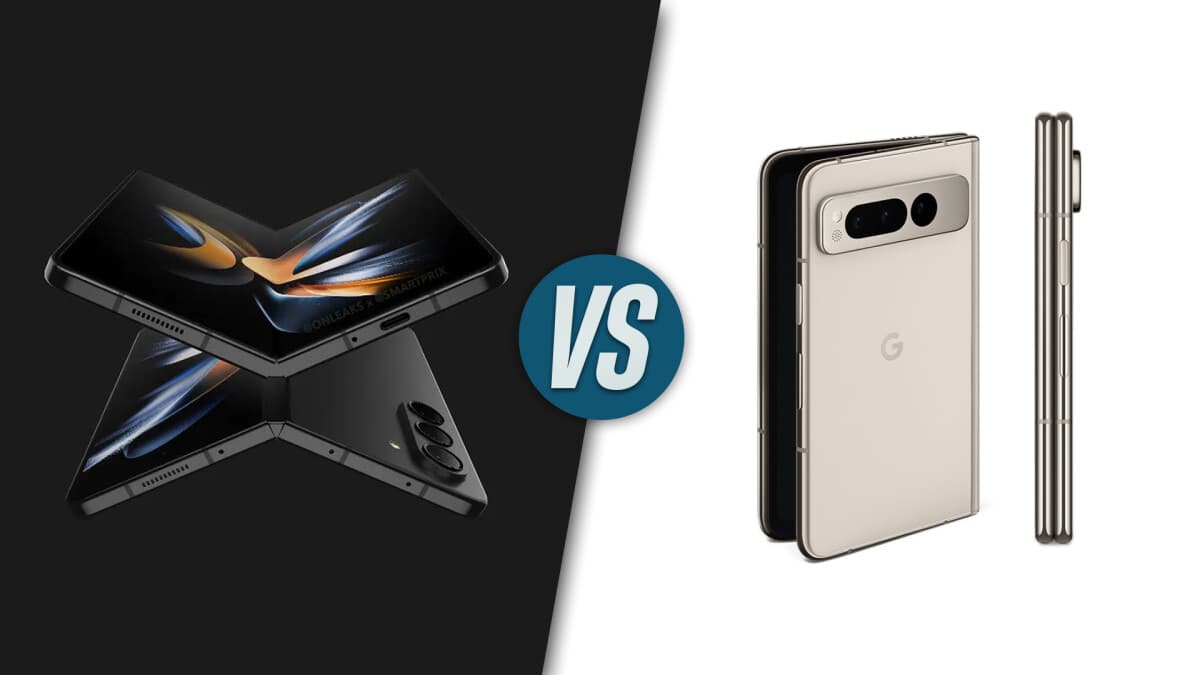
From inception, the Galaxy Z Fold series has had this weird external screen, where it’s way too tall and way too narrow. With an aspect ratio of around 23:9 (we expect the same for the Z Fold 5), it works for checking up on chats, mails, and calendar events quickly, and can be used for swipe-typing some quick messages. But once you decide to grab it with two hands and thumb-type away, it quickly starts feeling cramped.
So, a win for the Google design here, if you are one of the people who laments the narrow experience of a Galaxy Z Fold. As for construction, both phones will be ingress protected, with at least an IPX8 rating — the Z Fold 5 may have some sort of debris protection as well, but no word on that yet.
As for colors, we have Obsidian and Porcelain for the Pixel, which is basically white (beige-ish?) and black. The Z Fold 5 is rumored to come in beige, black, and a new light blue. So yeah, manufacturers don’t go overboard with color choices when it comes to premium phones. It’s better to play it safe.
Display Differences
So, we covered the aspect ratios in the above section, but what about the actual display panels and their technology? Well, it’s all OLED — both screens on both these devices use the tech, and it’s only logical, since LCD with backlighting just can’t work on a folding phone. Or can it?
In any case, we have 120 Hz refresh rates all around, HDR support, vibrant colors and high levels of peak brightness. The Pixel Fold does have this awkwardly thick bezel around the internal screen, but at least it also houses the selfie camera on that frame. Samsung will, no doubt, continue embedding the enternal selfie camera under the main screen, which is cool tech but hasn’t looked very impressive on the Z Fold phones thus far. Maybe this year it will?
For biometrics, don’t look at the screens — a fingerprint scanner will be embedded in the power button for both devices.
Performance and Software
Google’s Tensor G2 is just not a powerhorse
Samsung outfits its premium phones with the best and meanest processor of the time. And it looks like that, for the Galaxy Z Fold 5’s release, that’ll be the Qualcomm Snapdragon 8 Gen 2. No doubt, it will also be a “Made for Galaxy” variant — the one that is clocked slightly higher and hums inside the already-existing Galaxy S23 line.
Google puts its own Tensor G2 chip inside the Pixel Fold. On raw specs and benchmarks, it just can’t compete — not even with the Qualcomm Snapdragon 8+ Gen 1 from last year. But that’s not the race Google is participating in. The Tensor G2 is outfitted with cores specifically dedicated to computational photography and AI features, so the exclusive Google Assistant features and Photos editor work seamlessly on a Pixel phone.
We already touched a bit on software. The Google Pixel Fold launches with Android 13 with nothing but the pure Google features on it. This means the amazing speech-to-text capabilities of the Google Assistant, which can hold and screen calls for you, and the upcoming AI enhancements that will be able to compose messages for you. Plus the Magic tools in the Photos editor, which will no longer just erase objects, but crop them out of photos, allow you to move them around, and even “create” more of them should you decide you want to pull an object, which was cut slightly out of frame, towards the center.
Samsung’s software does have its own selling points. For one, it’s a full remake of the Android experience, so if you are not a fan of how Google has been handling it in the past couple of years (like the large quick tiles in the drop-down shade) — Samsung’s take is decidedly different and keeps some of the classic UI elements the way we are used to them. Alongside them, we have a floating dock, a floating handle for quick app launches, and the DeX Mode, which activates when you plug in an external monitor. By all means, the Z Fold 5 is a productivity machine and Samsung has spent years perfecting those software features.
The good news is that if you are interested in stylus use — both of these phones support a form of it. The Z Fold series, of course, supports the Samsung S Pen, which is excellent. But the Google Pixel Fold is compliant with USI 2.0 — a new standard which allows devices and styli to easily pair and work together. And, since in both cases, the stylus is a separate purchase, not much is different (besides the fact that Samsung has the Notes app designed around the stylus).
Camera
Good enough versus Magic
The Pixel Fold will have all the Google computational photography to back it up. It has a 48 MP main sensor, a 10.8 MP ultra-wide camera, and a 10.8 MP sensor under a 5x zoom lens. Yes, Google starts out with 5x optical zoom and goes from there. Sadly, this means it will use a digital crop for 2x and 3x Portrait Mode shots — same as the Pixel 7 — which we aren’t huge fans of. But, for other photos, we have no doubt it will give us some excellent results — stay tuned for the review.
The Galaxy Z Fold 5 is said to come with a new — larger than last year — 50 MP main sensor, 12 MP ultra-wide, and 12 MP 3x telephoto camera. Samsung does use that zoom lens for portrait shots, which is better. But will we see huge upgrades over last year’s Fold 4? We’d wager no, but that’s fine. The Galaxy Z Fold 4 had pretty good cameras — not as good or insane as the Galaxy S Ultra series, but that’s fine. The latter is Samsung’s dedicated “camera phone” series. The Folds have a different job to do.
Audio Quality and Haptics
The Galaxy Z Fold phones have been among the best-sounding handsets over the past couple of years. We don’t know what kind of witchcraft Samsung applies, but they sound wide, detailed, with a good amount of base (not necessarily bass) and chimey highs with no hardshness.
On the flip side, Google’s Pixel phones have also had great speakers thus far. The Pixel Fold only needs to repeat the formula. Which one will sound better? We will have to take a close listen, but we are pretty sure that the sound from both of these devices will be pretty satisfactory.
The same goes for haptics — both of these companies have mastered the vibration feedback and their premium phones click and clack with every tap and swipe over the interface.
Battery Life and Charging
4,400 vs 4,800
Still, the Galaxy Z Fold 4 managed to fit a 4,400 mAh cell in there and we expect the same capacity on the Galaxy Z Fold 5. The Pixel Fold, however, has a larger 4,821 mAh battery, which brings it closer to that 5,000 mAh that flagships typically come with.
The Galaxy Fold can charge with 25 W on the wire and it is said that the Z Fold 5 will support similar powers. Not an insanely high number, but the Z Fold 4 was capable of getting 50% charge in 30 minutes with a 25 W power brick, so not too bad. As for wireless charging, the Pixel stops at 7.5 W, while the Z Fold series can go up to 15 W with certain wireless pucks (like Samsung’s own chargers).
Specs Comparison
Thus far, we’ve discussed how the Galaxy Z Fold series usually tries to be on the cutting edge of hardware, whereas the Pixel phones have a slightly different take. But here are the raw specs, laid out:
| Galaxy Z Fold 5 | Google Pixel Fold | |
|---|---|---|
| Size, weight |
Unknown . Z Fold 4 specs for context: Folded: 155.1 x 67.1 x 15.8 mm Unfolded: 155.1 x 130.1 x 6.3 mm
263g (9.3oz) |
Folded: 139.7 x 79.5 x 12.1 mm Unfolded: 139.7 x 158.7 x 5.8 mm 283g (10oz) |
| Screen |
Main: 7.6″ OLED 9:10.8 ratio 120Hz
Cover: |
Main: 7.6″ OLED 10.8:9 ratio 120Hz
Cover: |
| Processor |
Qualcomm Snapdragon 8 Gen 2 Made for Galaxy, 4 nm |
Google Tensor G2 5 nm |
| RAM, Storage |
12 / 256 GB for $1,800 12 / 512 GB for $1,920 12 /1 TBGB for $2,160 LPDDR5X / UFS 4.0 |
12/256GB for $1,800 12/512GB for $1,920 LPDDR5 / UFS 3.1 |
| Cameras |
50 MP main 12 MP ultra 12 MP 3X zoom
10 MP front |
48 MP Wide camera 10.8 MP Ultra-wide 10.8 MP 5X Zoom
9.5 MP front |
| Battery | 4,400 mAh | 4,821 mAh |
| Charging |
USB-C 25 W wired 15 W wireless |
USB-C 21 W wired 7.5 W wireless |
*speculation
So, aside from processor and storage chip differences, the two devices shouldn’t be all that different in terms of hardware. Now, of course, Google needs to manage to optimize that Pixel software to get the maximum out of the Tensor G2 — as long as the Pixel Fold doesn’t feel sluggish (or get bogged down in a year or so), we won’t fault it for not having the hottest processor out there. That said, the Made for Galaxy Snapdragon 8 Gen 2 is hard to pass by…
Summary
So, there you have it — two distinct phones in the foldable space, about to start that battle for your attention. Both battle with the practicality of the form factor in slightly different ways, and offer different points of value.
Still, we are inclined to treat that Pixel Fold as a “gen 1 device”. If you are a Google enthusiast, or if you are one who has waited years for the form factor with a wide external screen — now might be your time. Otherwise, we would advise to tread cautiously. The first reviews of the Pixel Fold are just now coming in, and we are yet to complete our own.